Limitless Exchange Review 2026: Markets, USDC & Risks

Your view on the outcome. A clear look at the trade.
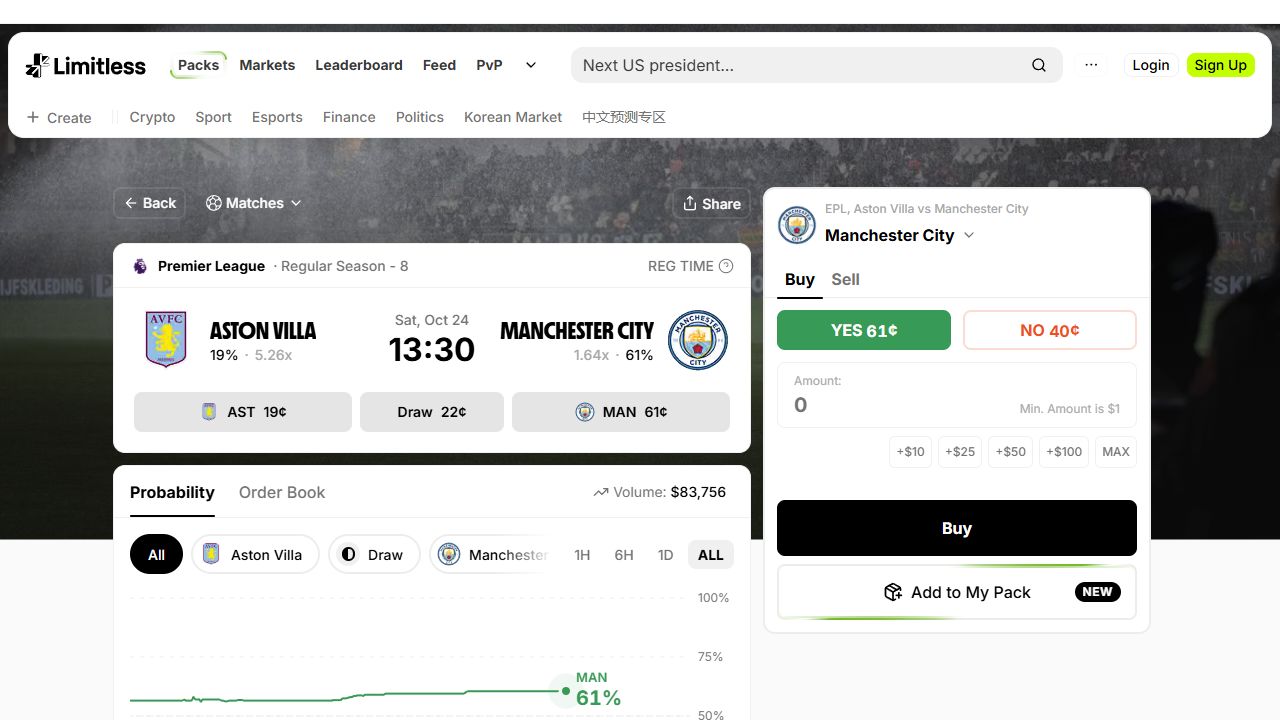
Sign in with Google or email, or connect an external wallet, to trade event outcomes with USDC on Base. The documented smart-wallet mode sponsors gas for supported actions; the price, trading fees and settlement rules still matter.
Who Limitless suits
Limitless is relevant to eligible users who want to trade event outcomes with USDC and inspect the price, order book and market rules themselves. Choose an alternative if your location is restricted, you need a different funding route, or you do not want wallet and execution responsibility.
Three strengths
- Event-outcome trading with a documented share model.
- Visible prices, order-book information and resolution rules.
- External and login-based wallet routes.
Three trade-offs
- Spread, fees and liquidity affect the real result.
- Wallet, contract and resolution risks remain.
- Eligibility varies by location and product route.
Product facts and full comparison context
Limitless at a glance
| Product type | On-chain prediction market |
|---|---|
| Network documented | Base |
| Collateral documented | USDC |
| Public categories observed | Crypto, sport, esports, finance, politics and regional markets |
| Position model | Outcome shares generally priced between $0.01 and $0.99 USDC |
| Winning outcome | Official documentation says a winning share pays $1; a losing share becomes worthless |
| Team testing | Reported by the owner; transaction dates, amounts and timing records are not attached here. |
How to interpret the findings
Limitless publishes documentation covering its market and settlement mechanics. Its official material describes the share-price model, collateral, Base settlement and resolution logic, while its public interface exposes current categories and market questions. That makes the mechanics easier to examine without relying entirely on promotional claims.
It is still not comparable with a slot casino or sportsbook on a single overall score. Prediction markets introduce different risks: market wording, liquidity, spread, order execution, resolution sources, smart-contract exposure and regional restrictions. The owner reports team testing; this review distinguishes those reported experiences from the dated public-screen observations and does not publish transaction-performance benchmarks without supporting records.
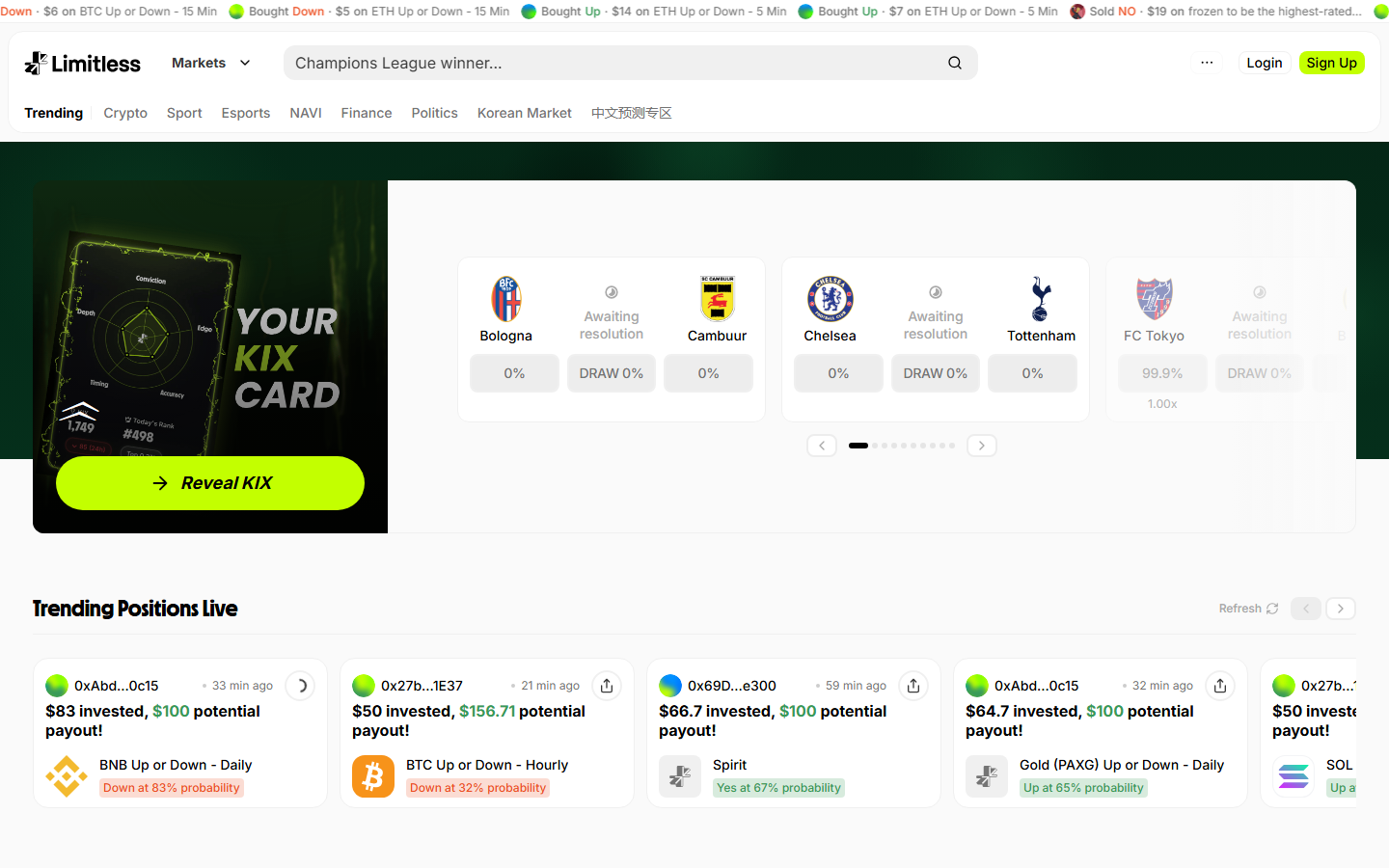
Historical interface: 1 August 2026
How Limitless prediction markets work
Each market represents one or more possible outcomes. The official documentation describes YES and NO shares priced between $0.01 and $0.99 USDC. A price of $0.62 can be read as the market collectively pricing an outcome at roughly 62%, but it is a traded price rather than a guarantee or objective probability.
Opposing positions are collateralized so that the winning share can redeem for $1 after resolution. A user can hold until resolution or may be able to sell earlier, subject to available liquidity and the price another participant is willing to accept. This creates several practical differences from placing a fixed sportsbook bet:
- The entry price can move as other users trade.
- A position may be exited before resolution if sufficient liquidity exists.
- The spread and available order depth can materially affect the real cost of entering or leaving.
- The exact market wording and named resolution source determine what counts as a winning outcome.
Sports, esports, crypto and other markets
The interface captured by OptiHax displayed navigation for crypto, sport, esports, finance, politics and other collections. The sports area included match markets and longer-term questions; crypto pages included short-duration and event-based asset questions. These categories change as markets open and resolve.
For every market, users should check the close time, outcome definitions, resolution source and any special edge cases. A headline question alone is not enough. Ambiguous wording, cancelled events, postponed matches, data-source outages and ties can all matter to settlement.
How USDC funding works in three steps
Start with the wallet route you actually use. The funding network is Base, and the supported collateral is USDC; the receiving address and network must agree before any transfer.
- 01
Choose Google, email or your wallet
Use a documented Google/email sign-in route or connect an external wallet. Identify the embedded account and smart trading wallet shown by the product; these are distinct modes, not interchangeable names for a universal gas-free account.
- 02
Fund with USDC on Base
Use the receiving address displayed for your chosen wallet and transfer supported USDC on Base. If your funds are on another network, use an appropriate bridge first; a token with the same name on another chain is not the same deposit route.
- 03
Check the balance and trading mode
Confirm the balance in the intended wallet before opening an order. The documented smart-wallet mode sponsors supported gas costs, so that mode does not require ETH for those actions. External-wallet transfers normally need ETH for their own gas, and trading fees remain separate.
Official wallet and funding instructions
This process diagram summarizes the documented wallet routes. Check the transaction preview for the route you actually use.
Wallet and collateral detail
Wallets, USDC and settlement
Official Limitless material describes a non-custodial product on Base using USDC collateral and on-chain conditional claims. “Non-custodial” does not mean risk-free: users still interact with applications, wallet permissions, contracts, order systems and resolution mechanisms.
Before funding a position, confirm:
- The wallet is connected to the intended Base network.
- The token is the exact supported USDC contract, not a lookalike asset.
- The approval request is limited to the amount and contract you intend to use.
- The quoted price, order size and potential payout match your expectation.
- You understand any network cost, trading fee, spread and redemption step.
This review does not publish a measured deposit, order or redemption cost benchmark from the team’s reported tests. Current fees and transaction steps must be checked in the interface before signing.
What stands out
Outcome shares
Separate the event question from the quoted price and potential payout. A winning share’s payout includes the amount paid to buy it.
Order-book visibility
Compare bid, ask and depth before sizing an order. The price available to buy can differ from the price available to sell.
Market-specific rules
Read the settlement source and treatment of postponed or disputed events. A correct sporting prediction can still differ from the defined market outcome.
Choice of wallet route
Understand external versus login-based access and smart-wallet permissions. Gas sponsorship is distinct from trading fees.
Market-screen checklist and decision framework
The outcome can be right. The trade can still disappoint.
What exact event settles the market, and which source decides? Read exceptions as carefully as the headline.
A displayed percentage is not necessarily the price available for your full order. Check spread, depth and fees.
Selling needs a counterparty; redemption needs resolution and settlement. Neither is the same as transferring funds to another wallet.
This is a framework for evaluating the product, not a prediction strategy or evidence of profitable trades.
Four details worth checking on the market screen.
| Visible detail | Question to resolve |
|---|---|
| Price and order size | Is this a chart label, indicative price or executable quote for the quantity selected? |
| Bid, ask and depth | What price could you actually receive if you sell? |
| Rules and source | Do the outcome, timestamp and resolution source agree? Pause if the wording conflicts. |
| Settlement status | Has the market resolved, and is redemption ready? These can be separate stages. |
Our 23 October public-screen research found differing resolution references in one Bitcoin market. That is a reason to clarify that market’s rules, not evidence that every Limitless market is ambiguous. No order was submitted.
Historical market examined · Official order-book explanation
Real markets, readable details
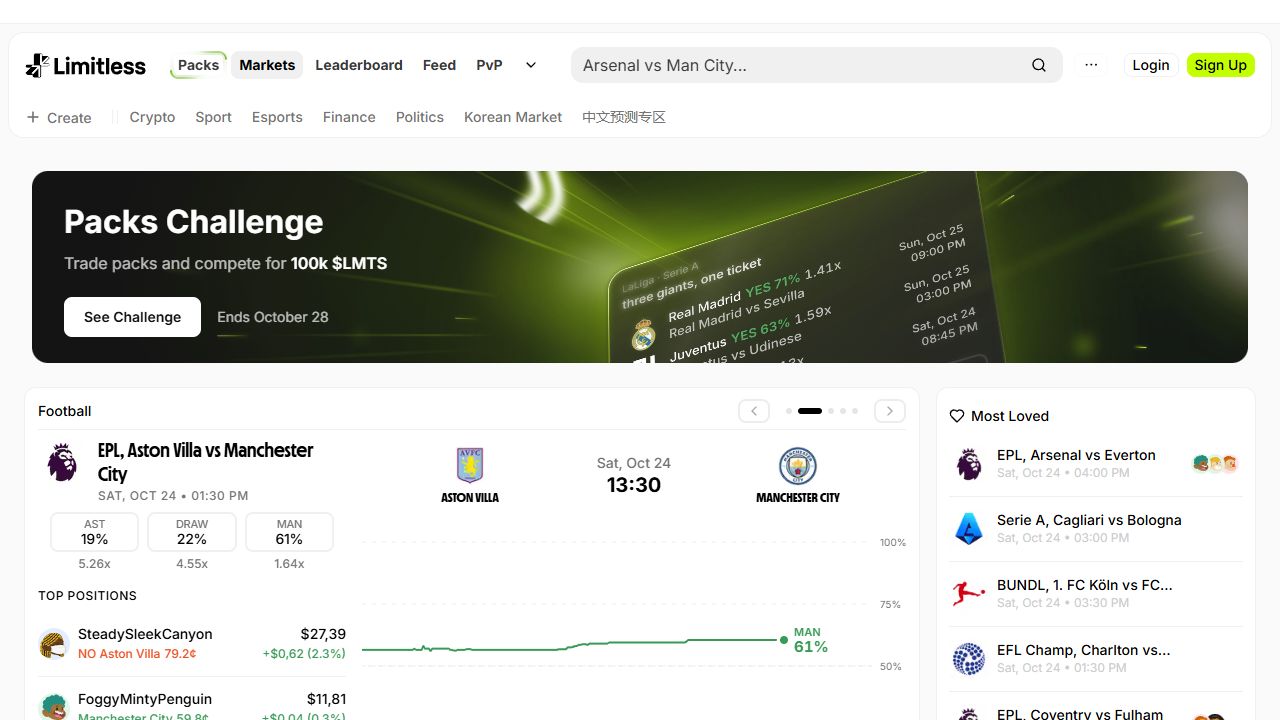
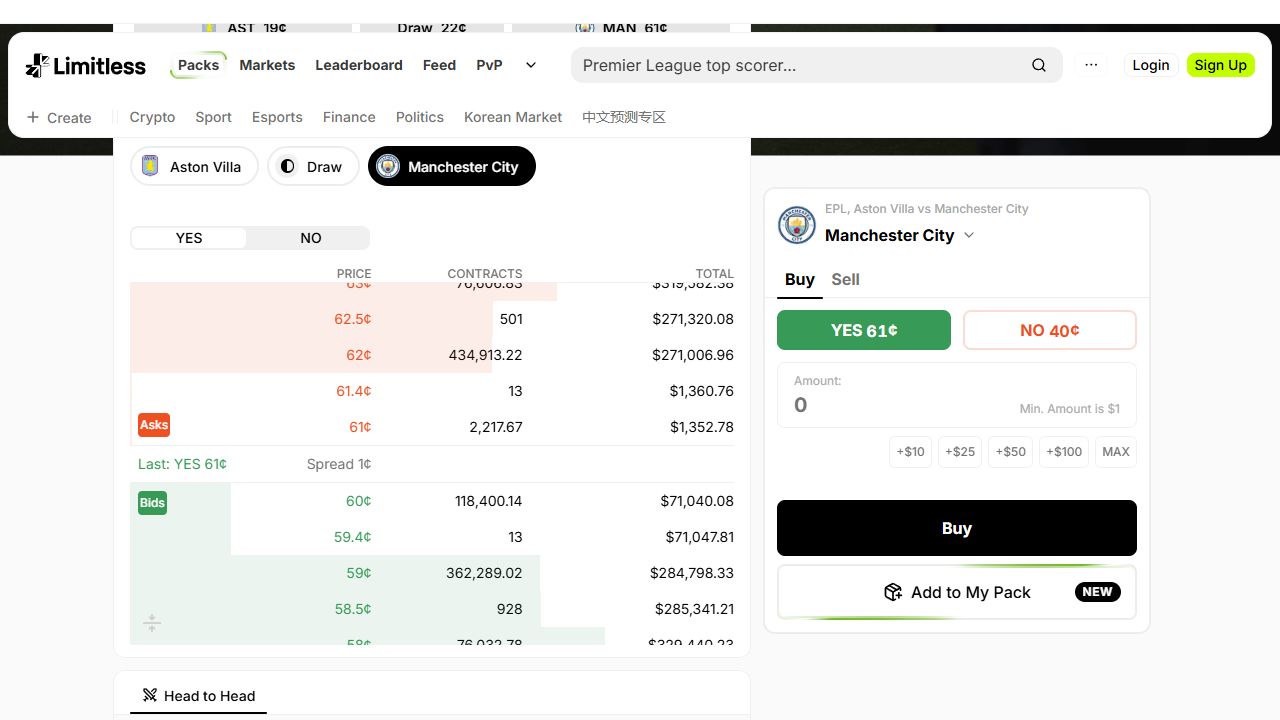
The dated sports example connects the market price, book and rules. Open the captures at full size; current markets and quotes can differ from these historical observations.
The original screen-by-screen walkthrough
Original public-screen walkthrough · 24 October 2026
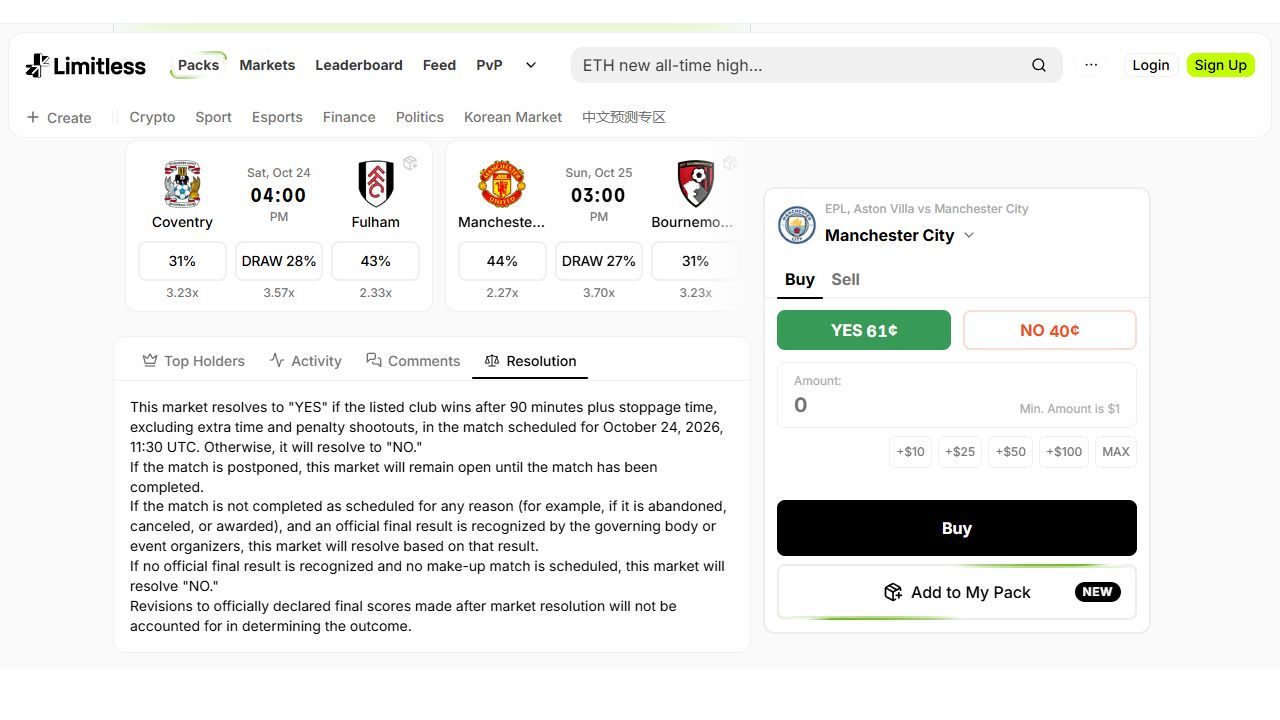
During the public-screen session, we inspected a sports market, expanded its resolution terms and examined its order book. That session did not include a wallet connection or executed trade. Here is what those screens help you check—and what they cannot establish. Source market ↗
1. Separate the headline from the quoted price
The observed sports screen priced Manchester City YES at 61¢ and NO at 40¢. Buying one YES share at 0.61 USDC would cost 0.61 before fees, if that quote filled. A successful 1-USDC settlement would return the original stake plus 0.39 before fees—not 1 USDC of profit. A losing YES share would return zero.
2. Inspect the price available to an exit
The book showed a 0.61 ask and 0.60 bid. In a simplified example, buying 100 shares at the ask costs 61 USDC; immediately selling at that bid returns 60 before fees. The 1-USDC difference is a spread cost, even without the market moving. This assumes sufficient depth and full fills at both quotes; displayed depth is a snapshot, not a guarantee either order will fill at that price.
3. Read what counts as a win
This market used the result after 90 minutes plus stoppage time, excluding extra time and penalties. Its listed match time was 24 October 2026 at 11:30 UTC. Postponement, an unfinished match and later result revisions each have specific treatment. A club advancing in a competition is therefore not interchangeable with winning this market.
The quoted price is only the beginning
Why buying at 61¢ and selling at 60¢ matters
The dated order-book capture showed a 61¢ best ask and a 60¢ best bid. These are opposite sides of the order book: buying at the ask and selling at the bid are different transactions.
At an exact full fill, the purchase costs 61 USDC before fees.
If a buyer fills all 100 shares at that bid, gross proceeds are 60 USDC: a 1 USDC loss before fees.
The screenshot does not establish enough depth for that size. Partial fills, fees and changing prices can make the actual result different.
Limitless fees: identify the venue before calculating profit
The official fee documentation distinguishes legacy CLOB markets, new venues, standard AMM and custom pools. Do not apply a single fee percentage to every market. In particular, legacy buy fees can be deducted in shares, whereas the new-venue illustration below assumes fees paid in USDC.
A hypothetical 100-share trade, including fees
This example assumes the documented standard new-venue taker formula of 5% × (1 − share price), exact fills, and no other costs. This new-venue formula is separate from the pictured sports example. Our public market-data check on 24 October 2026 at 12:21 UTC returned the documented legacy-venue structure for the Manchester City outcome in that match. It did not establish an actual charged fee or an executable quote. See the official distinction between legacy and new venues. It is a calculation lesson, not a reported trade.
100 shares × 0.60 = 60 USDC.
Fee: 2% × 60 = 1.20.
Total outlay: 61.20 USDC.
Gross sale: 70 USDC.
Fee: 1.5% × 70 = 1.05.
Net received: 68.95.
Profit: 7.75 USDC.
If each share settles at 1 USDC: 100 returned, 38.80 net profit before other costs.
If it settles at zero: 61.20 lost.
A limit order is not automatically fee-free: it must actually provide liquidity to qualify for the documented maker treatment. Confirm the current order preview, venue schedule and settlement conditions. Transfer or network costs, slippage and partial fills can change the result.
Payout diagram before fees
Separate payout from profit.
Suppose 100 shares cost 0.60 USDC each: the position costs 60 USDC before fees. All dollar-denominated amounts in this example represent USDC. These are illustrative assumptions, not a live quote or trade.
If a buyer fills all 100 shares, sale proceeds are $70 and gross profit is $10 before costs.
Under an ordinary binary winning outcome, redemption is $100 and gross profit is $40 before costs.
The losing position returns $0. The $60 purchase cost is lost, plus any fees paid.
Market-specific exceptions can change settlement. Fees reduce the results above; wallet-transfer costs and readiness to redeem are separate questions. This overview deliberately does not assume one fee schedule applies to every market.
Identify the applicable fee model · Read settlement and redemption rules
Selling, redeeming and withdrawing are different
Selling outcome shares requires a buyer and an executable price. Redeeming follows the market’s resolution and settlement process. Sending USDC to another address is a wallet transfer. Treat these as separate stages when planning an exit rather than assuming an apparent profit is already a transferable balance.
The official wallet guide describes the Withdraw action for the social/smart-wallet route and normal wallet transfers for external accounts. Verify the destination is an intended Base address and check any network or wallet charges in your own transaction preview. Sponsorship for one mode does not mean every route or action is free.
Wallet withdrawal routes · Settlement and redemption
Support and dispute routes
Support and dispute questions
The official documentation points users to a support channel and the address [email protected]. The owner reports team contact with support. This review does not publish a measured response time or a documented dispute-resolution outcome. Before trading, confirm the applicable escalation route for account, settlement or smart-contract disputes.
Risks and regional access
Check eligibility before funding. Market wording, liquidity, wallet approvals and smart-contract exposure can affect your funds. A winning prediction can still be a poor trade at the wrong price; use only a risk budget you can afford to lose.
Access rules, identity information and full risk checklist
Eligibility, wallet access and security: three separate checks
Who can use Limitless?
The current terms distinguish access exclusions from trading restrictions. Trading restrictions include the United States, “Republic of China” (the document’s exact wording), Ontario and Alberta. This is not a complete list. Check the full current terms and your local requirements; a working website or wallet connection does not establish eligibility. We do not recommend bypassing restrictions.
External wallet versus login-based wallet
The wallet documentation describes external wallets and login-based embedded/smart-wallet routes. Your route affects which address controls funds and how you access the account. Before transferring, confirm the receiving address, supported network and token in the current interface. Selling shares, redeeming a settled position and transferring USDC are distinct actions; our public-screen walkthrough did not test any of them.
What the security audit claim covers
The security documentation references audits of upstream contracts and distinguishes them from Limitless modifications. An upstream audit is not a blanket audit of every change, market rule or user journey. This distinction belongs beside any security claim.
Compare prediction-market routes, not casino scores
For differences in product routes, access, costs and settlement, see our Kalshi vs Polymarket vs Limitless comparison. The right comparison depends on your location and intended market, not an unsupported universal ranking.
Identity and operator information
The official privacy policy reviewed by OptiHax names Street Chow Inc., incorporated in Panama, and describes collection that can include identity documents, financial information and transaction history. The policy also states that information may be processed for account operation, legal compliance, fraud detection and anti-money-laundering purposes.
A wallet-based interface should therefore not be described as guaranteed anonymous or permanently KYC-free. Identity requirements may depend on location, risk controls, account activity and current terms. The owner reports team signup testing, but a completed signup does not establish eligibility for every reader. This public-screen walkthrough did not verify a new account’s eligibility.
Important risks
What can affect the result
- Market wording and resolution source
- Liquidity and bid–ask spread
- Event cancellation or disputed data
- Smart-contract and interface failures
What can affect your funds
- Wrong network or token
- Malicious wallet approvals
- Phishing and fake domains
- Trading more than you can afford to lose
A winning prediction can still produce a poor trade if the entry price is too high, the spread is wide or the position cannot be exited when expected. Prediction markets should not be treated as an investment strategy or reliable income source.
Questions before using Limitless
Is Limitless a crypto casino?
No. It is better described as an on-chain prediction market. It does not use the same product model as slots, live casino or a traditional sportsbook, so OptiHax assesses it under separate criteria.
Which cryptocurrency does Limitless use?
The official documentation describes USDC collateral on Base. Always verify the current network and exact token contract in the interface before transferring or approving funds.
Does a 70-cent share mean a 70% chance?
It reflects the current traded price and can be interpreted as the market’s approximate implied probability. It is not a guarantee, and liquidity or spread can affect the price.
Has OptiHax tested a Limitless withdrawal?
The owner reports that the OptiHax team tested withdrawals. The screenshots in this review document a separate public-interface session, not that withdrawal. A transaction record, amount, date and elapsed time are not attached here, so this review does not claim a verified withdrawal-speed benchmark.
Do I need ETH as well as USDC?
It depends on the wallet route. The documentation describes sponsored smart-wallet actions, while external-account transfers ordinarily need ETH for gas. Confirm the mode and transaction preview; gas sponsorship does not remove trading fees.
Can I cash out before a market resolves?
You may be able to sell shares if a counterparty and sufficient liquidity are available. The bid, spread and order size determine the executable result; a displayed chart price is not a guaranteed exit price.
Our evidence and review scope
- Product captures
- Public market screens, order book and resolution terms captured on 24 October 2026, plus separately dated research and a labelled historical interface view.
- Team experience
- The owner reports testing signup, deposits, product use, withdrawals and support. Exact transaction records and timings are not attached; this review does not turn that report into a measured performance benchmark.
- Worked examples
- The 61¢/60¢ calculation uses a photographed order-book snapshot. The separate fee example states a different assumed venue. Both are illustrative arithmetic, not executed trading results. The dated order-book illustration is separate from the fee model assumed in the new-venue example. It does not report a trade or promise an executable quote.
- Sources
- Official documentation supports funding, fees, wallet modes and settlement. Interface observations and documentation are identified separately from team-reported experience.
Full methodology, original sources and historical interface
How we reviewed Limitless
We inspected the public market interface, prices, order book and resolution rules, and reviewed the official documentation. Captures and observations carry their dates beside the relevant examples.
The dated public-screen session did not include account creation or funding, wallet connection, trade execution or redemption, identity verification, withdrawals or support contact. The owner separately reports that the team tested signup, deposits, product use, withdrawals and support. Exact dates, amounts, timings and outcomes are not presented as independently checked results without supporting records. The calculations illustrate stated assumptions; they are not reported trading results.
Primary sources
- Limitless public market interface
- Limitless official documentation
- Limitless product and market explanation
- Limitless privacy policy
- Limitless platform changelog
Funding and access sources checked 25 October 2026: wallet types and gas sponsorship and first-trade guidance.
Compare the current product with this review
Check the market question, order preview and settlement rules before deciding whether to trade.
Trade on Limitless ↗18+ · Eligibility and terms apply. OptiHax may earn commission from qualifying referrals.