No KYC Crypto Casinos — What Anonymous Really Means in 2026
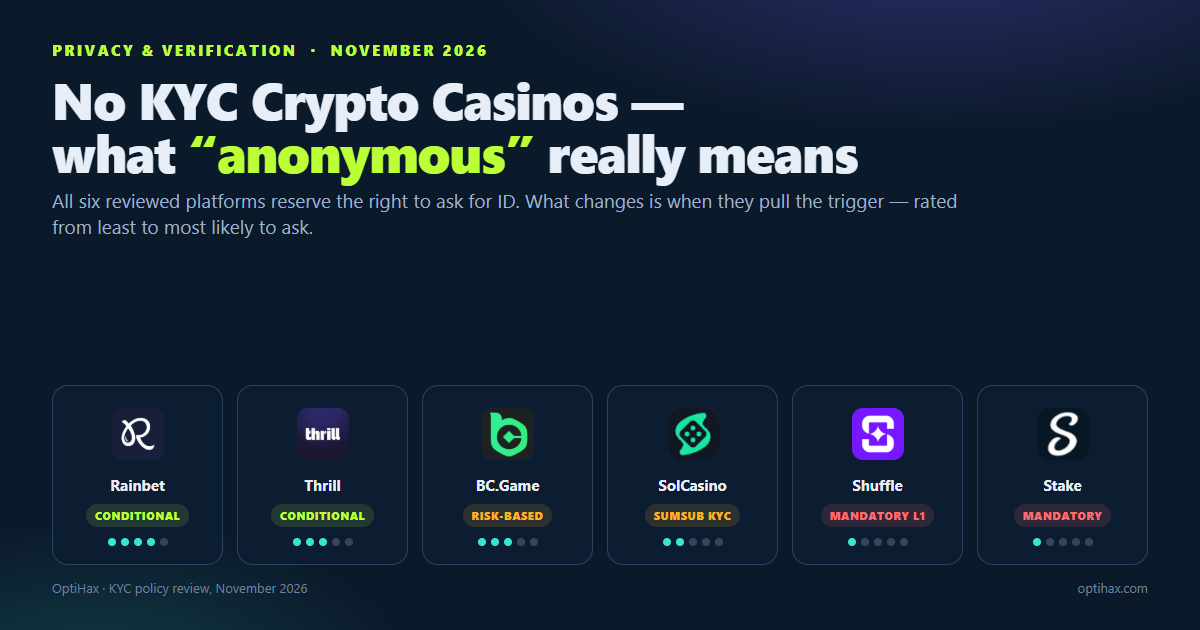
Privacy & Verification
No KYC Crypto Casinos — What “Anonymous” Really Means in 2026
Every crypto casino markets itself as “no KYC” or “anonymous.” The reality? Almost all of them reserve the right to demand full identity verification at any time. We break down which casinos actually let you play privately — and which ones are just delaying the inevitable.
The Honest Truth
The “No KYC” Myth: What Crypto Casinos Won’t Tell You
Before you deposit a single satoshi, you need to understand what “no KYC” actually means in 2026.
Here’s the uncomfortable truth that most affiliate sites won’t tell you: there is no such thing as a truly “no KYC” crypto casino — at least not among reputable operators. Every licensed casino, regardless of jurisdiction, includes clauses in their terms of service that allow them to request identity verification at any time, for any reason.
What varies is when and how aggressively they enforce it. Some casinos require full ID before you can even deposit. Others let you play for months before anything is triggered. And a few genuinely try to minimize verification — but always with the caveat that they can ask if they want to.
The marketing term “no KYC crypto casino” really means “no upfront KYC” — and even that only applies to some platforms. When you’re searching for an “anonymous bitcoin casino” or a “crypto casino without verification,” what you’re really looking for is a platform that minimizes the chances of being asked for ID. That’s a meaningful difference, and it’s one we can actually measure.
We’ve analyzed the terms of service, user reports, licence requirements, and real withdrawal experiences across every major crypto casino. Here’s what we found.
Three Categories
How Crypto Casino KYC Actually Works
Every casino falls into one of three categories. Understanding these tells you more than any marketing page ever will.
Mandatory KYC
Always Required
Full identity verification required before you can play, deposit, or withdraw. No exceptions. These casinos have dropped the “anonymous” pretense entirely — you’ll need government ID, proof of address, and sometimes source-of-funds documentation.
Examples: Stake, Shuffle (Level 1)
Risk-Based KYC
Triggered by Behaviour
No upfront verification, but the casino monitors your activity and can demand KYC at any time. Common triggers: large withdrawals, unusual betting patterns, suspected multi-accounting, or accumulated volume thresholds. You might play for months — or get flagged on day one.
Examples: BC.Game
Conditional KYC
Rare But Possible
The closest to “no KYC” you’ll find. These platforms don’t perform routine verification and many users complete their entire lifecycle without ever being asked. But the terms still allow it — typically for large cashouts, regulatory inquiries, or suspicious activity.
Examples: Rainbet, Thrill
Side-by-Side
KYC Comparison: All 6 Casinos Ranked by Privacy
Sorted from most privacy-friendly to least. Privacy rating based on real enforcement, not marketing claims.
| Casino | KYC Type | When Triggered | Documents | Licence | Privacy Rating |
|---|---|---|---|---|---|
 Rainbet |
Conditional | Large withdrawals, suspicious activity — no routine checks | ID, proof of address (if triggered) | Anjouan (RBGAMING N.V.) |
|
 BC.Game |
Risk-Based | Large withdrawals, risk flags, suspicious activity — anytime | ID, selfie, proof of address, source of funds | Anjouan (Twocent Technology, Belize) |
|
 Thrill |
Conditional | Per terms — crypto-only model reduces triggers significantly | ID (if triggered) | Anjouan (Costa Rica operator) |
|
 SolCasino |
Automated (Sumsub) | Automated checks — stricter than “no KYC” marketing implies | ID verification via Sumsub (automated) | Tobique |
|
 Shuffle |
Mandatory (L1) | Required before full access; additional levels for higher limits | ID, selfie — higher levels require more | Curaçao (Natural Nine B.V.) |
|
 Stake |
Mandatory | Required before deposits, play, and withdrawals — no exceptions | Government ID, proof of address, source of funds | Curaçao (Medium Rare N.V.) |
|
Detailed Breakdowns
Each Casino’s KYC Policy — Ranked by Privacy
From most anonymous-friendly to most verification-heavy. Honest assessments only.
Conditional#1 Most Private
Rainbet — “No Routine KYC” for Crypto Play
Rainbet is the most privacy-friendly option among our reviewed casinos. They explicitly state “no routine KYC” for crypto-only users, and community reports suggest most players complete their entire lifecycle without being asked. However, their terms clearly reserve the right to request verification for large withdrawals, suspicious activity, or regulatory requirements. The $15 minimum withdrawal and 1x deposit turnover requirement are standard. Processing targets 5–15 minutes.
Privacy Pros
- No routine KYC for crypto users
- Most users never get asked
- Fast 5-15 min withdrawal processing
- Crypto-only reduces trigger surface
Privacy Cons
- KYC can be triggered anytime per ToS
- Anjouan licence — weak jurisdiction
- Limited dispute resolution options
- $15 minimum withdrawal
Risk-Based#2 Privacy-Friendly
BC.Game — No Upfront KYC, But They’re Watching
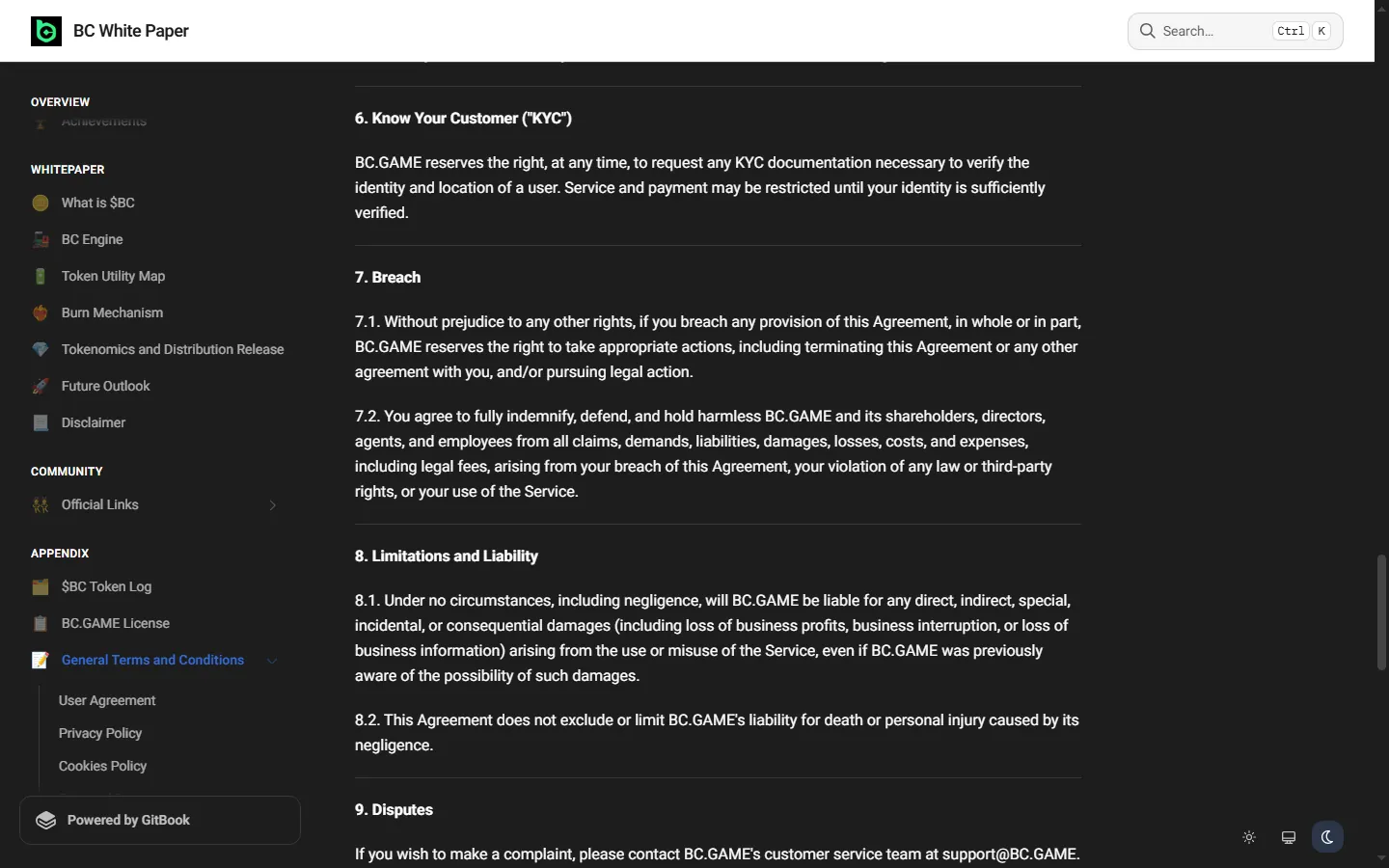
BC.Game doesn’t require KYC upfront for crypto users, making it a popular choice for privacy-focused players. However, their risk-based system means verification can be triggered at any time — large withdrawals, unusual patterns, or accumulated volume can all set it off. The elephant in the room: BC.Game’s previous operators went bankrupt in November 2024, leaving an estimated $2–2.5 million in player funds unpaid. New ownership took over, but the precedent matters. Also notable: a strict €10K/month withdrawal cap (€5K when winning).
Privacy Pros
- No upfront KYC for crypto deposits
- Sign up with email only
- Huge game library (12,000+)
- Multiple crypto options
Privacy Cons
- Risk-based — can trigger anytime
- Previous operator bankruptcy ($2-2.5M unpaid)
- €10K/month withdrawal cap
- Entity “not found” per Belize FSC
Conditional#3 Privacy-Friendly
Thrill — Crypto-Only Model Keeps KYC Triggers Low
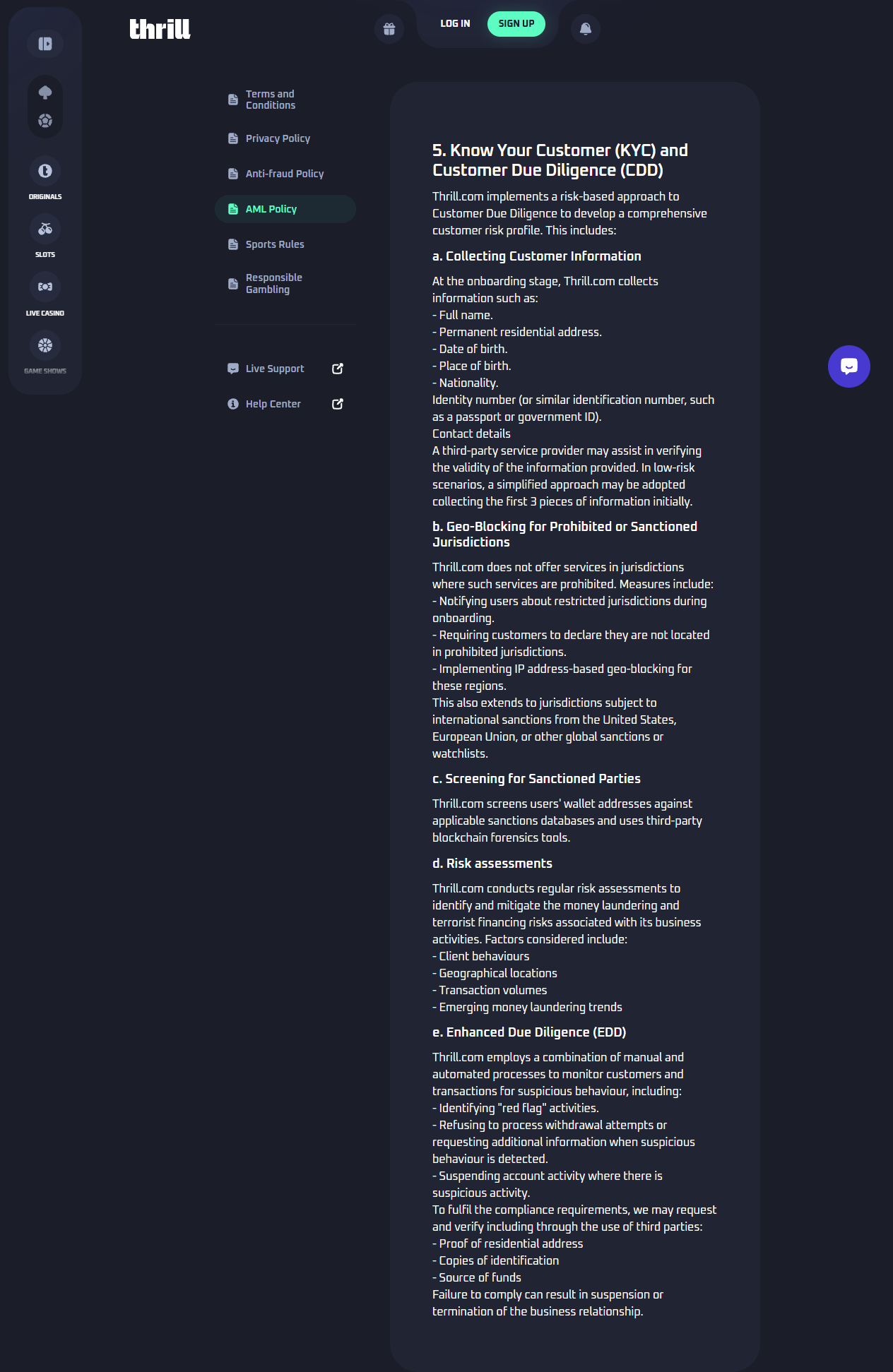
Thrill launched in 2025 as a crypto-only platform, which inherently reduces the regulatory touchpoints that typically trigger KYC. Being crypto-native means no fiat on-ramps, no bank connections, and fewer compliance obligations. KYC is still possible at any time per their terms, but the crypto-only model means the typical triggers (fiat conversion, bank wire thresholds) simply don’t exist here. The $5,000 max withdrawal per transaction is worth noting — high rollers may find this limiting.
Privacy Pros
- Crypto-only reduces KYC triggers
- No fiat = fewer compliance obligations
- New platform with modern approach
- Relatively low KYC enforcement reports
Privacy Cons
- KYC still possible per ToS
- $5,000 max withdrawal per tx
- Anjouan licence, Costa Rica operator
- Launched 2025 — limited track record
Sumsub KYC#4 Mixed Privacy
SolCasino — Automated Verification Is Stricter Than You’d Expect
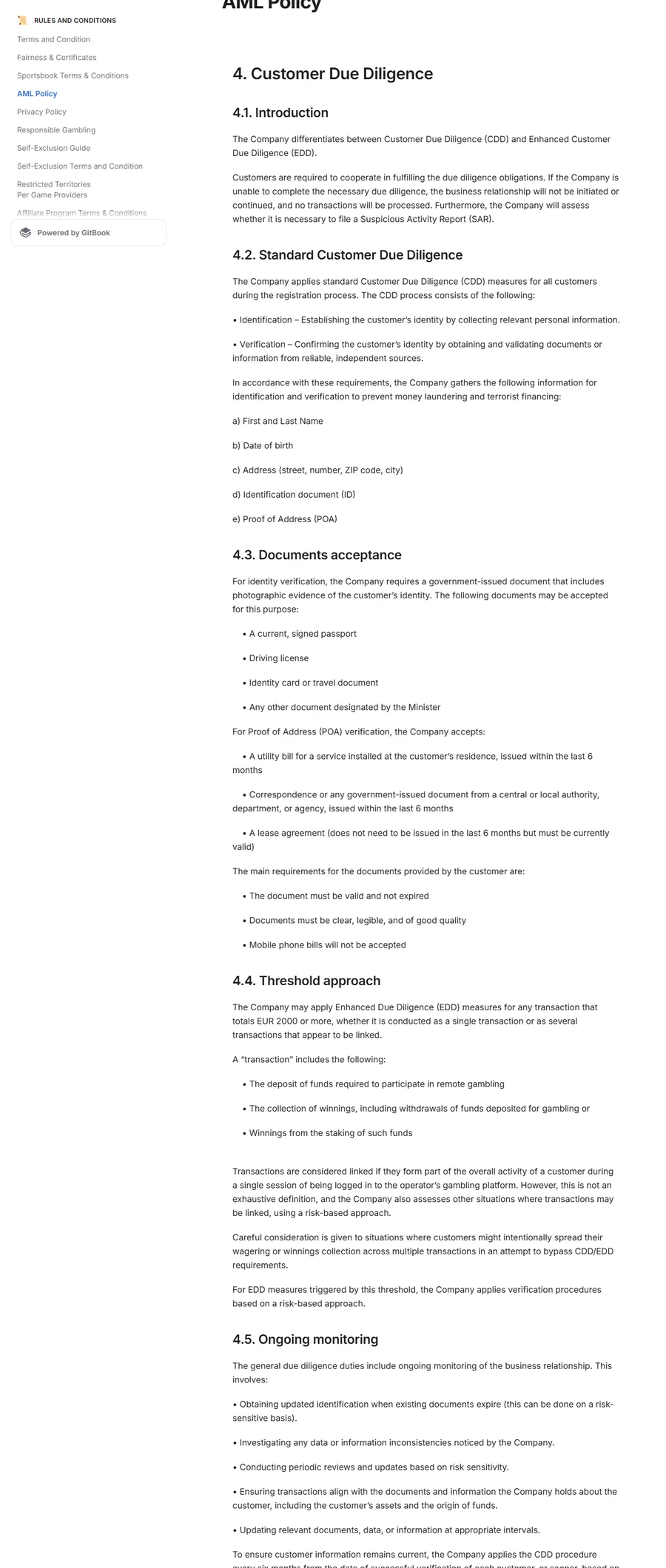
SolCasino markets itself as a Web3-native casino with Solana wallet integration, which sounds privacy-friendly on the surface. The catch: they use Sumsub for automated identity verification, which is the same enterprise KYC provider used by major exchanges like Binance. This means verification isn’t just possible — it’s systematized and can be triggered automatically. The Tobique licence (among the weakest regulatory frameworks) means less oversight but also less player protection.
Privacy Pros
- Web3 wallet integration (no account needed)
- Solana-native — fast transactions
- Crypto-only platform
- Decentralized feel
Privacy Cons
- Sumsub automated KYC — enterprise-grade
- Stricter than marketing suggests
- Tobique licence — weakest framework
- Verification data stored by third party
Mandatory L1#5 Limited Privacy
Shuffle — Mandatory Level 1 KYC Before Full Access
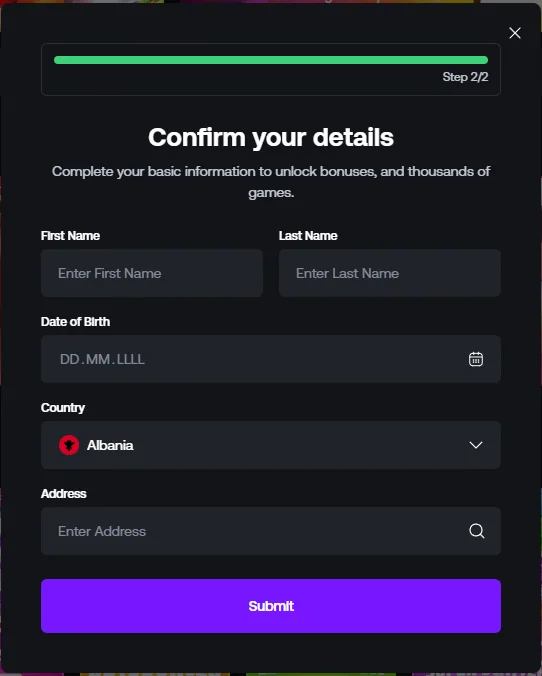
Shuffle requires Level 1 KYC before you get full platform access — there’s no dancing around it. Additional verification levels may be required for higher withdrawal limits or larger play volumes. Reddit reports paint a concerning picture: multiple users report being forced into additional KYC on large cashouts, with $12K–$20K held for weeks during the verification process. If you’re privacy-conscious, Shuffle isn’t the platform for you.
Privacy Pros
- Curaçao licence (stronger than Anjouan)
- Clear KYC policy — no surprises
- At least you know what you’re signing up for
Privacy Cons
- Mandatory KYC — no way around it
- Additional levels for large withdrawals
- Reports of funds held weeks during KYC
- $12K-$20K cashouts flagged for extra review
Mandatory#6 Least Private
Stake — Fully Mandatory KYC Since ~2025
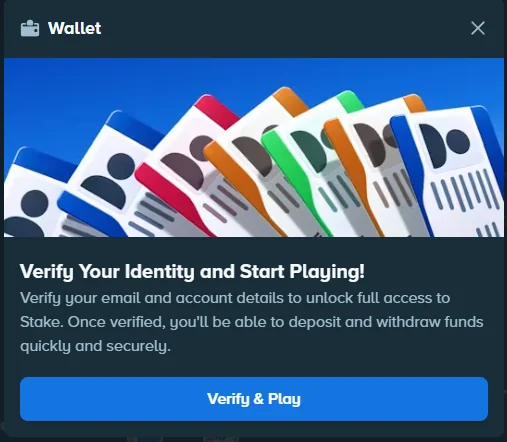
Let’s be direct: Stake is not a no-KYC crypto casino. If you landed on this page looking for anonymous play, Stake should not be on your list. Since approximately 2025, Stake requires full identity verification before you can deposit, play, or withdraw. They’ve also added a 1x deposit turnover requirement on all crypto deposits before withdrawal. Stake is the industry giant with the best game selection and VIP program — but privacy is not part of the package.
Privacy Pros
- Curaçao licence — established operator
- Largest platform — less exit scam risk
- Clear, upfront policy — no bait-and-switch
Privacy Cons
- Full mandatory KYC — zero anonymity
- Verification before any deposits
- 1x deposit turnover before withdrawal
- Source of funds documentation possible
Know The Triggers
What Actually Triggers KYC at “No KYC” Casinos
Even at the most privacy-friendly platforms, certain behaviours raise flags. Here’s what to watch for.
Large Withdrawals
The #1 trigger. Cashing out significantly more than you deposited — especially in a single transaction — almost always flags a manual review. Thresholds vary but $5K–$10K is a common trip wire.
Suspicious Patterns
Unusual betting patterns, rapid deposits/withdrawals without gameplay, or strategies that look like money laundering (e.g., betting both sides) can trigger automated risk systems.
Accumulated Volume
Even if individual transactions are small, high cumulative volume over time can cross thresholds. Some platforms track lifetime deposits and flag accounts at certain milestones.
Bonus Abuse Flags
Claiming multiple bonuses, creating duplicate accounts, or meeting wagering requirements through low-risk strategies can trigger both KYC and account investigation.
Regulatory Requirements
Licensing bodies can audit operators and require them to verify specific accounts. Even the most relaxed jurisdictions (Anjouan, Tobique) have baseline compliance obligations.
Eyes Wide Open
The Real Risks of “No KYC” Crypto Casinos
Privacy comes at a cost. Here’s what you’re accepting when you choose anonymous play.
Weak Licences = Weak Protection
The casinos with the most relaxed KYC policies tend to hold the weakest licences. Anjouan and Tobique offer minimal player protection compared to Curaçao, Malta, or the UK. If something goes wrong, your options for dispute resolution are essentially zero. The licence exists on paper but offers little practical recourse.
Frozen Funds with No Recourse
Here’s the nightmare scenario: you win big, request a withdrawal, and suddenly you’re asked for KYC. If you can’t or won’t complete verification, your funds are frozen indefinitely. Multiple Reddit reports describe exactly this — players who assumed “no KYC” meant “never KYC” finding their five-figure balances locked behind verification walls.
Exit Scam Potential
Operators with minimal regulatory oversight and no connection to your identity have less reputational incentive to honor withdrawals. While major platforms are unlikely to exit scam, smaller “no KYC” operators have disappeared overnight, taking player funds with them. Due diligence matters more here than anywhere else.
Case Study: BC.Game Bankruptcy (Nov 2024)
The most relevant cautionary tale: BC.Game’s previous operators went bankrupt in November 2024, leaving an estimated $2–2.5 million in player funds unpaid. New ownership took over operations, but affected players had virtually no legal recourse. The Belize-registered entity was literally “not found” by the country’s Financial Services Commission. This is what can happen when you trade privacy for regulatory protection — and it happened at one of the biggest platforms, not some unknown operator.
The Privacy Paradox
There’s an uncomfortable tension at the heart of “no KYC” gambling: the same lack of oversight that protects your privacy also means nobody is watching out for you. Provably fair algorithms can verify game outcomes, but they can’t protect you from frozen funds, altered terms, or disappearing operators. Every player needs to decide where their personal risk threshold sits. Our recommendation: never deposit more than you can afford to lose entirely, and consider spreading your activity across multiple platforms to limit exposure to any single operator.
Common Questions
No KYC Crypto Casino FAQ
Straight answers to the questions every privacy-conscious gambler asks.
Are there truly “no KYC” crypto casinos in 2026?
Not really — at least not among reputable operators. Every licensed crypto casino includes terms that allow them to request identity verification at any time. What varies is enforcement. Platforms like Rainbet and Thrill have “conditional” KYC where most users are never asked, but the legal right to demand verification always exists. Truly anonymous options exist on unlicensed, decentralized platforms — but those carry significantly higher risks of rug-pulls and unfair games.
What’s the difference between “no KYC” and “no upfront KYC”?
“No KYC” implies verification is never required — which is marketing fiction at licensed casinos. “No upfront KYC” is more honest: it means you can sign up, deposit, and start playing without immediately submitting identity documents. But KYC can be triggered later by withdrawals, suspicious activity, or regulatory requirements. When you see “no KYC crypto casino,” mentally translate it to “no upfront KYC” and you’ll have more realistic expectations.
Can a “no KYC” casino freeze my funds and demand verification?
Yes, absolutely. This is the most common complaint in crypto gambling forums. A player deposits and plays without verification, wins a significant amount, requests a withdrawal, and is suddenly asked for full KYC including government ID, proof of address, and sometimes source-of-funds documentation. If they can’t or won’t comply, funds remain frozen. This is legal under the terms of service that every player agreed to — even if they didn’t read them. Always assume this can happen.
Which crypto casino has the least KYC enforcement?
Among our reviewed casinos, Rainbet currently has the lightest touch with conditional-only KYC and no routine verification for crypto users. Thrill is similar with its crypto-only model reducing typical triggers. However, “least enforcement” doesn’t mean “no enforcement” — and enforcement policies can change overnight as regulatory pressure increases. We update this page regularly, but always check the casino’s current terms before depositing.
Is it safe to use a no KYC crypto casino?
It depends on your definition of “safe.” Your funds are at higher risk at no-KYC platforms because they tend to hold weaker licences with less player protection. The BC.Game bankruptcy ($2–2.5M unpaid) is a real example of what can go wrong. That said, millions of players use these platforms daily without issues. Practical safety tips: never deposit more than you’d accept losing entirely, use a dedicated email address, withdraw profits regularly rather than letting them accumulate, and diversify across platforms.
What documents do crypto casinos typically ask for during KYC?
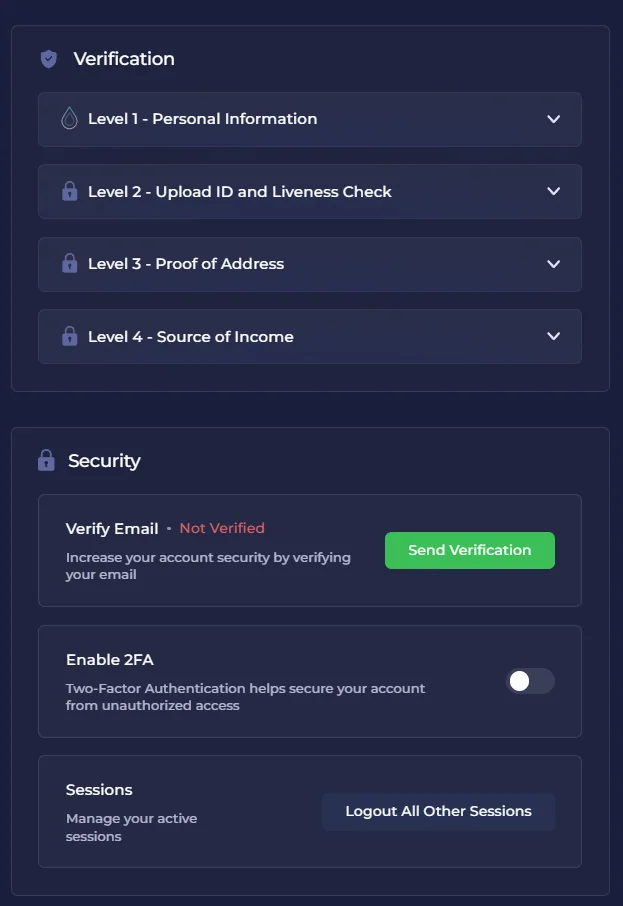
Standard KYC typically involves three tiers: Level 1 — government-issued photo ID (passport, driver’s licence, national ID card). Level 2 — proof of address (utility bill, bank statement within 3 months) and sometimes a selfie holding your ID. Level 3 — source of funds documentation (pay stubs, tax returns, or proof of crypto holdings origin). Most casual players only encounter Level 1, but high-volume players and large withdrawals can trigger Level 2 or 3.
Does using a VPN help avoid KYC at crypto casinos?
A VPN can hide your IP location but doesn’t protect you from KYC. Casinos trigger verification based on on-platform behaviour (withdrawal amounts, betting patterns, volume), not your IP address. Using a VPN to access a casino from a restricted jurisdiction actually increases your risk — if discovered, it’s grounds for account termination and fund seizure. VPNs are a privacy tool for general browsing, not a KYC bypass for gambling platforms.
Why do crypto casinos require KYC at all?
Three reasons: Anti-Money Laundering (AML) compliance — even weak jurisdictions like Anjouan and Tobique have baseline AML requirements. Licence obligations — the gaming licence requires operators to “know their customer” when certain thresholds are hit. Risk management — casinos use KYC to prevent multi-accounting, bonus abuse, and fraud. Some casinos (Stake, Shuffle) have decided the compliance burden of delayed KYC isn’t worth it and now require verification upfront — which is arguably more honest than pretending it won’t happen.
The Bottom Line
Choose Your Privacy Level — With Eyes Wide Open
“No KYC crypto casino” is a marketing term, not a guarantee. Every platform in this guide can — and will — ask for verification under the right circumstances. The question isn’t whether KYC exists, but how likely you are to encounter it. We’ve ranked these casinos by real-world privacy, not advertising claims. Pick the level of privacy that matches your risk tolerance, never deposit more than you can lose, and always read the terms.