Death.fun Review 2026: Abstract Games, ETH & Risks
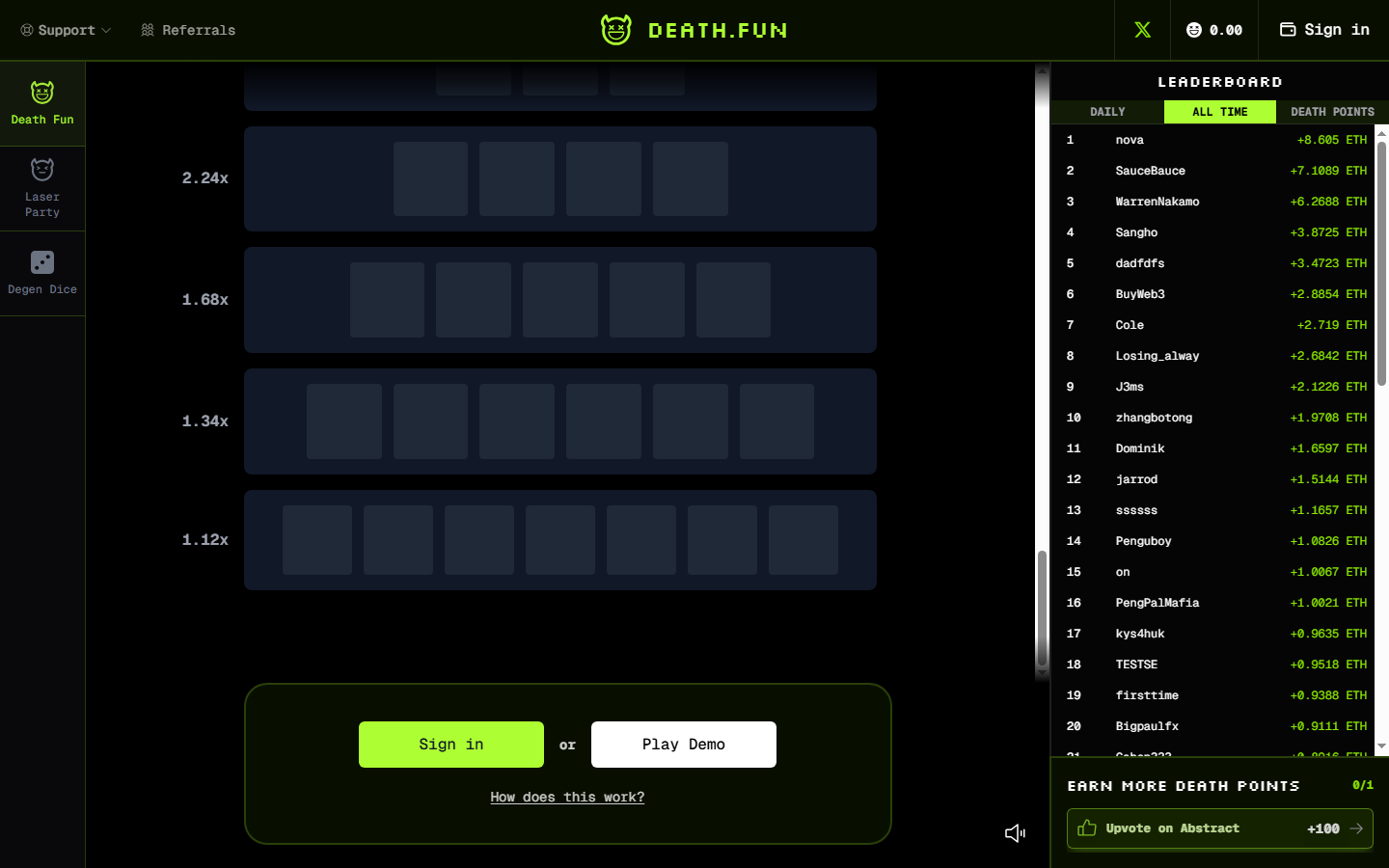
Death.fun is an on-chain luck-game platform on Abstract. Its main game asks players to advance through rows of hidden outcomes, accept rising multipliers and cash out before revealing a losing tile. This profile documents the public mechanics, ETH exposure and verifiable-history features while identifying the operator, contract and funded tests still missing.
Death.fun at a glance
| Product type | On-chain multiplier and mines-style luck games |
|---|---|
| Network observed | Abstract |
| Wager asset displayed | ETH |
| Public games observed | Death Fun, Laser Party and Degen Dice |
| Public test option | Demo mode available |
| History fields displayed | Bet, result, multiplier, payout transaction, hash, seed and verification |
| OptiHax funded test | Not completed |
18+ only. Check current rules, contract addresses and legal eligibility before connecting a wallet. The button currently uses the official destination, not an OptiHax tracking link.
Our early verdict
Death.fun is easier to understand than a large casino lobby. The central decision is visible: keep advancing for a higher multiplier or stop and cash out. Demo access also allows a visitor to inspect the rhythm before putting ETH at risk, while the stats area exposes fields intended to support result and payout verification.
Simplicity does not remove the main risks. Rapid rounds, sharply rising multipliers and public leaderboards can encourage repeated play. On-chain settlement adds wallet, network and contract exposure. Most importantly, OptiHax has not yet found enough public operator and legal information to treat the product as fully documented. The profile therefore remains unscored.
How the main game works
The public game board displays rows associated with increasing multipliers. A player chooses a path through the hidden tiles. Surviving a row increases the available cash-out value; hitting the losing outcome ends the round. The probability of continuing safely falls as the multiplier rises.
The critical decision is not whether a particular tile “looks lucky.” Hidden outcomes should be treated as random under the published game mechanism. Previous rounds, leaderboard results and winning streaks do not make the next selection safer.
Death Fun, Laser Party and Degen Dice
OptiHax observed three navigation options:
- Death Fun: the main row-advancement game with multipliers beginning close to the original stake and rising sharply across later rows.
- Laser Party: a related format with a different multiplier curve.
- Degen Dice: a dice-based progression game displaying numbered choices and a changing next multiplier.
Each format requires its own probability and house-edge check. A multiplier table by itself does not establish expected return. OptiHax still needs the complete rules and calculation used to map random outcomes to every result.
Abstract, ETH and wallet risk
Death.fun operates on Abstract and displays ETH-denominated activity. The native currency on Abstract is ETH, but an Abstract address and an Ethereum-mainnet address should not be treated as interchangeable transfer routes. The official Abstract guidance warns users not to send funds over an unsupported network.
Before signing any transaction:
- Confirm the wallet is on Abstract.
- Verify the official Death.fun domain and contract destination.
- Read the transaction simulation and approval scope.
- Keep enough ETH for any network cost and use a small first amount.
- Do not sign an unexplained token approval or share a recovery phrase.
“On-chain” does not automatically mean non-custodial at every stage or safe. Contract permissions, upgrade controls, frontend integrity, bankroll design and payout logic all need examination.
Game history and verification
The public stats page includes columns for payout transaction, hash, seed and verification. That is a useful foundation because it can connect a displayed result to a reproducible calculation and an on-chain payout.
OptiHax still needs to complete the full loop: record a pre-round commitment, play a demo and funded round, reveal the seed, reproduce the outcome and compare the payout transaction with the displayed result. Until that is done, we describe the interface as offering verification fields rather than declaring every game independently verified.
Operator identity and recourse
The public game pages inspected for this profile did not provide enough visible legal-entity and dispute information for OptiHax to verify the operator. A smart contract and public transaction history can improve transparency, but neither replaces a clear legal entity, current terms, privacy information, regional restrictions and a formal complaint route.
This gap is material. If a frontend blocks access, a wallet account is restricted or a payout is disputed, users need to know which organization is responsible and what recourse exists.
Safer-play considerations
Death.fun combines short rounds, immediate multiplier feedback, leaderboards and points. These can encourage fast repetition. Use demo mode to understand the mechanics, set a hard ETH budget before connecting a funded wallet and never increase the stake to recover a previous loss.
OptiHax has not yet verified deposit limits, time-outs, self-exclusion or account-blocking tools. The absence of a conventional casino account may make some standard controls harder to implement, not less important.
What OptiHax still needs to test
| Check | Status |
|---|---|
| Operator identity, terms and restricted regions | Pending |
| Official contract addresses and administrative controls | Pending |
| Wallet sign-in and transaction permissions | Pending |
| Small ETH wager and payout transaction | Pending |
| Seed, hash and result reproduction | Pending |
| House edge across all three games | Pending |
| Support, complaint route and safer-play controls | Pending |
Death.fun FAQ
What kind of game is Death.fun?
Its main product is an on-chain mines-style progression game. Players advance through hidden outcomes for increasing multipliers and can cash out before revealing a losing tile.
Which network does Death.fun use?
The public interface and ecosystem information place it on Abstract, using ETH. Always verify the network and destination before moving funds.
Can results be verified?
The stats page exposes hash, seed, payout-transaction and verification fields. OptiHax has not yet reproduced a funded result end to end.
Has OptiHax tested a payout?
No. The interface and demo product have been inspected, but a funded wager and payout test is still pending.
Sources
- Death.fun public game interface
- Death.fun public stats and verification fields
- Death.fun Laser Party
- Death.fun Degen Dice
- Abstract official wallet and network guidance
- DefiLlama Death.fun protocol page (secondary source)